Your SPF 30 foundation is protecting you like an SPF 3
The 20-second version. The arithmetic is below.
I used to believe my foundation. It said SPF 30 on the bottle, I put it on every morning, and for years I counted that as sun protection. Then I learned how the number is measured, and I have not counted it since.
This is not a story about a bad product. Most SPF foundations do exactly what their label says, under the conditions of the test. The test is the problem, or rather, the gap between the test and your bathroom.
How an SPF number is made
Every SPF you have ever read was measured the same way. A lab applies the product to a volunteer's back at a fixed dose: 2 milligrams per square centimetre. Then they shine UV on that patch of skin, and on an unprotected patch next to it, and compare how much light it takes to produce a faint redness on each. If the protected skin needs 30 times the dose, the product is SPF 30.
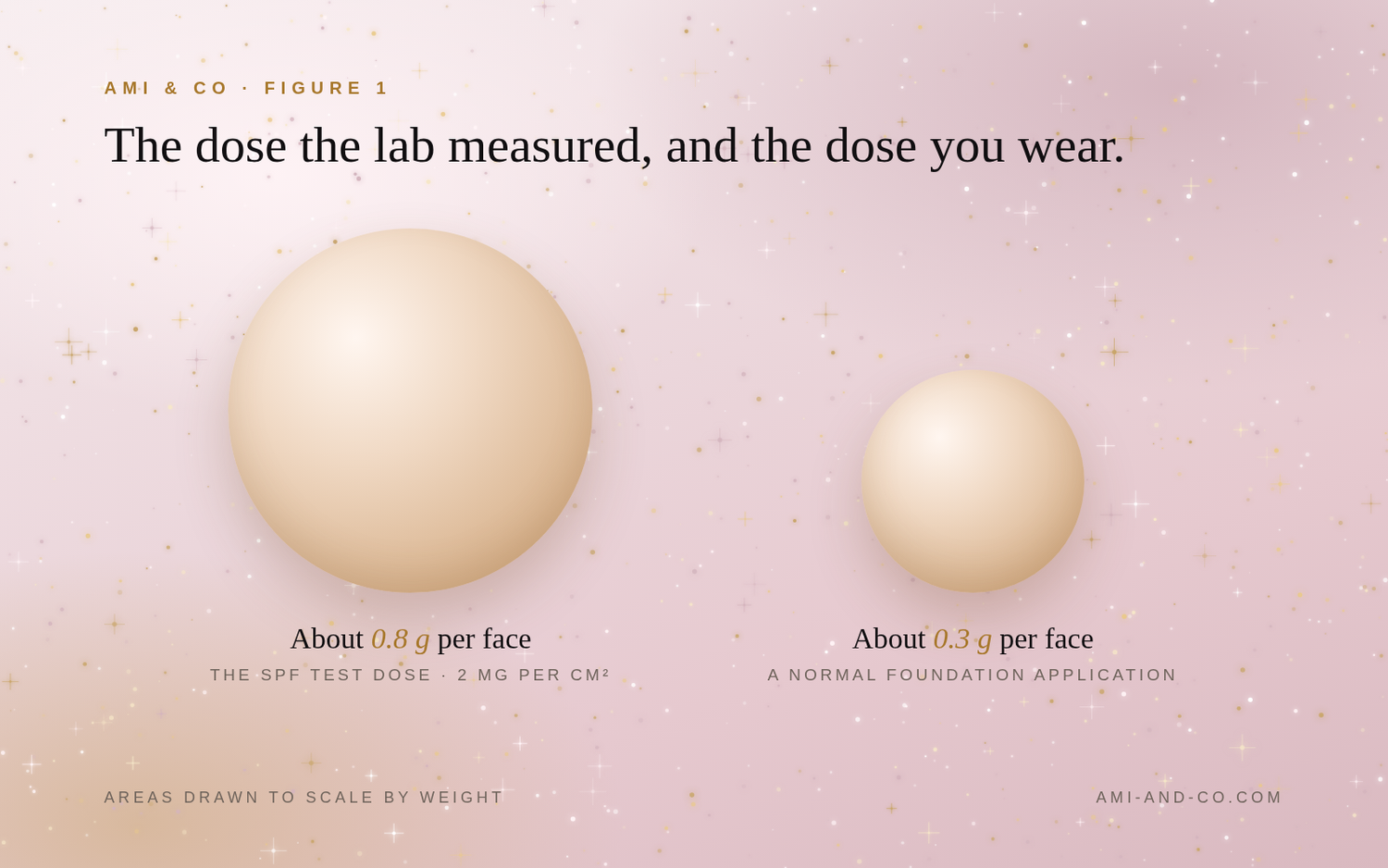
Two milligrams per square centimetre is a lot. It is a thick, visible, slightly greasy layer. On a face, which is roughly 400 square centimetres once you include the hairline and the jaw, it works out to about 0.8 grams of product. If you have a kitchen scale, that is a real, weighable amount. It is roughly a quarter teaspoon.
Now think about how much foundation you actually use. One pump. Half a pump on a good skin day. Blended out until it disappears, because that is the entire point of foundation. Nobody wants a visible layer.
Nobody wears the test dose
This is not me guessing. The gap between the lab dose and real life is one of the best documented things in sunscreen research, and it applies to sunscreen itself, before we even get to makeup.
When researchers weigh what people actually apply, the numbers come in far below 2 mg/cm². A European study of students found a median of 0.39 mg/cm². A UK study of photosensitive patients, who had every reason to be careful, found around 0.5 mg/cm². Another found medians of roughly 0.9 to 1.5 mg/cm² depending on the texture. The consistent finding, across countries and decades, is that people apply somewhere between a fifth and three quarters of the tested amount.
Foundation is worse, for a simple reason. Sunscreen is at least trying to be a layer. Foundation is trying to be invisible. It is sheered out, buffed with a sponge that keeps a good share of it, and then powdered. Weigh your own: put your foundation bottle on a kitchen scale, do your face, put it back. Most people land somewhere between 0.2 and 0.4 grams. That is a quarter of the test dose, sometimes less.
What a quarter dose does to the number
Here is where it gets interesting, because scientists disagree about the exact shape of the curve, and the disagreement is worth knowing.
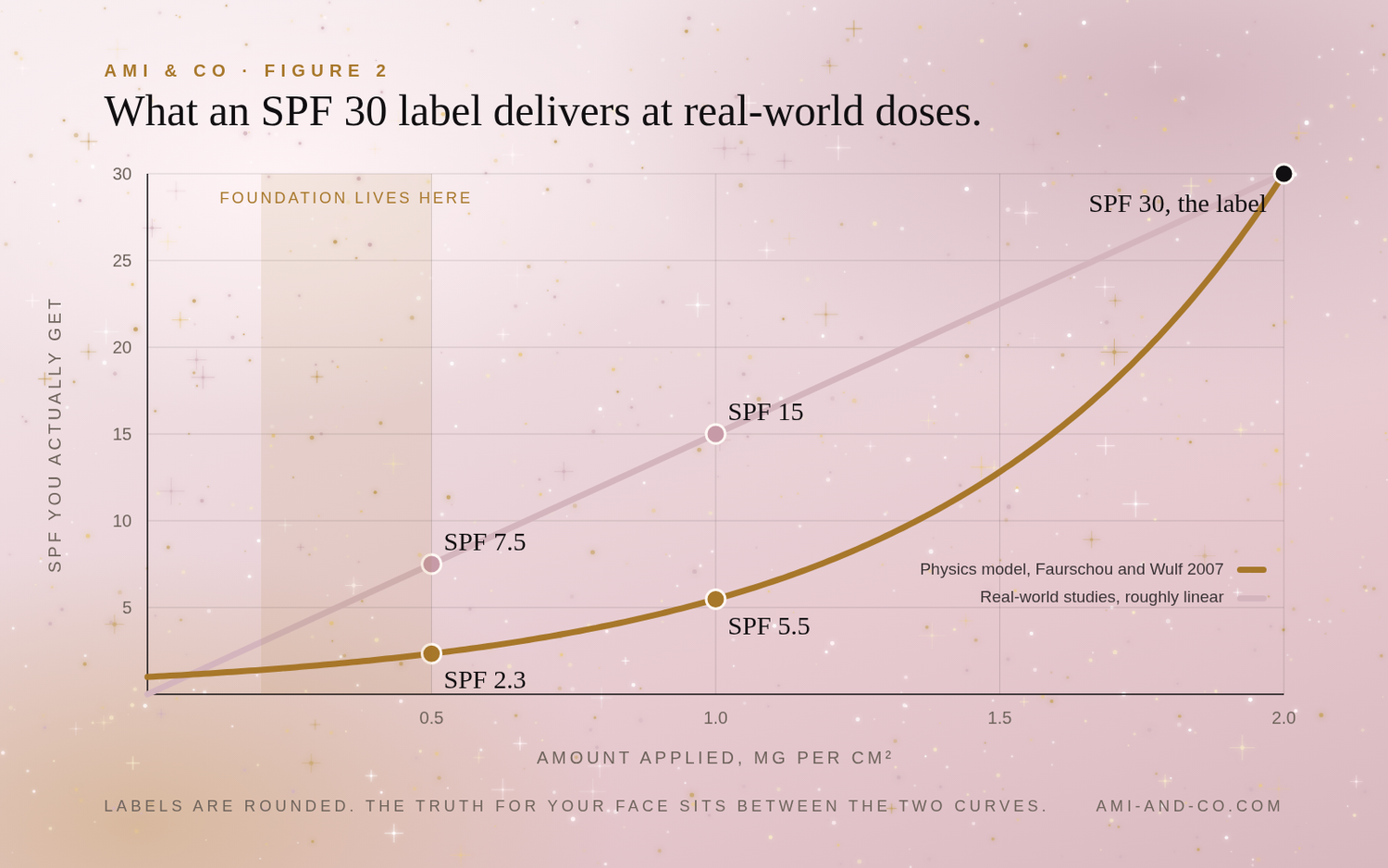
The physics answer, from a 2007 Danish study that measured SPF at several doses, is that protection falls off exponentially. Halve the dose and you do not get half the SPF, you get the square root of it. Quarter the dose and you get the fourth root. Under that model, an SPF 30 applied at a quarter of the test dose gives you an SPF of about 2.3. At half the dose, about 5.5.
The empirical answer, from later studies that measured real products on real skin, is kinder. In practice the drop looks closer to linear: half the dose gives roughly half the SPF, a quarter dose gives roughly a quarter. Under that model, your SPF 30 at a quarter dose is about SPF 7 or 8.
So the honest range for a normal application of SPF 30 foundation is somewhere between SPF 3 and SPF 8. Neither end is the number on the bottle. Neither end is what dermatologists mean when they say wear sunscreen. And an SPF 15 foundation, which is the more common label, lands between roughly 2 and 4.
That is why I say SPF 3 in the short version of this. It is the physics number, it is memorable, and even if you prefer the kinder curve, you are still wearing a fraction of what you thought.
What SPF in foundation is actually for
I do not think SPF in foundation is a scam. I think it is a formulation feature that got promoted to a health claim by the way we read labels.
Inside the formula, UV filters do useful things. Some of them are the same minerals that give the product coverage, so the SPF is almost a side effect. They protect the pigments and the formula itself from degrading in light. And for the thin layer you do wear, they add a little. A little is not nothing. If you already have a proper sunscreen underneath, SPF foundation on top is a small bonus. The failure is when it is the only thing.
There is also a quieter issue. Foundation is put on once, in the morning, and not reapplied, because reapplying foundation at 2 pm is not a thing people do. Sunscreen, by contrast, is meant to be topped up if you are outside. So the foundation layer is both thinner and older by the afternoon.
The protocol I actually use
Sunscreen first, at something close to the real dose. For a face that means two finger lengths of product, or the quarter teaspoon, or 0.8 grams on the scale if you are the kind of person who likes to see the number once. Let it set for a few minutes. Then foundation, as little as you like, with or without SPF, because it is no longer doing that job.
If you hate the feeling of two layers, the fix is a lighter sunscreen, not a heavier foundation. Japanese sunscreens are very good at this. Many of the milk and gel textures disappear well enough that foundation goes on over them without pilling, and a few are designed as makeup bases.
If you want one number to remember: the test dose is four times what you put on your face. Whatever SPF your foundation says, divide it by four to be generous, and then decide whether that is the protection you meant to wear.
The bigger point
I write about this because it is the cleanest example I know of a true claim that misleads anyway. The label is accurate. The test is standardised. The chemistry works. And the product still does not do what the person buying it thinks it does, because the number was measured under conditions that have nothing to do with a Tuesday morning.
That is the question I ask about every claim in this industry, on foundations and on much more expensive things. Not "is it true", but "true under what conditions, and are those my conditions."
Wash your face. Wear the real sunscreen. Then put on whatever you like.
Sources used for the numbers: Faurschou and Wulf, British Journal of Dermatology 2007 (exponential relation between SPF and amount applied); Schalka et al., Photodermatology, Photoimmunology and Photomedicine 2009; the 2010 Journal of the American Academy of Dermatology study of amount applied and SPF in Asian skin; Petersen and Wulf, Photodermatology, Photoimmunology and Photomedicine 2014 (application in theory and reality); Autier et al. and Azurdia et al. on real-world application amounts, summarised in Cosmetics and Toiletries.
