Salmon DNA, and the 500 dalton problem

In one breath: PDRN is salmon DNA, and it is 100 to 3,000 times too big to cross intact skin. The serum on your shelf and the injection at the clinic are two different treatments wearing the same four letters. Here is what each one can actually do, and the one question to ask before you pay a premium.
Every shelf has PDRN on it now. Serums, eye creams, sheet masks, ampoules with a little fish on the box. The pitch is always some version of the same sentence: salmon DNA repairs your skin.
I want to be careful here, because there are two completely different things wearing the same four letters. One of them is a clinic procedure with real human trials behind it. The other is a serum in your bathroom. They are not the same treatment, and most of the marketing quietly hopes you will not notice the difference.
So here is what PDRN actually is, what a topical version can and cannot do, and what the injected version looks like when you read the studies instead of the before-and-afters.
What PDRN actually is
PDRN stands for polydeoxyribonucleotide. It is a mixture of DNA fragments, purified from salmon sperm, with molecular weights between about 50 and 1,500 kDa, most commonly clustering around 80 to 200 kDa.
Two mechanisms get cited for it.
The first is receptor signalling. PDRN behaves as an agonist at the adenosine A2A receptor, which is an anti-inflammatory and pro-repair switch. In fibroblast experiments the effects disappear when an A2 antagonist is added, which is how we know the receptor is doing the work rather than something else in the mixture.
The second is the salvage pathway. When tissue is stressed or low on oxygen, it cannot build nucleotides from scratch efficiently. PDRN breaks down into nucleosides and nucleotides that a cell can pick up and reuse, like handing bricks to someone who cannot run the kiln right now.
Both of those mechanisms are real. Both of them happen in the dermis, where fibroblasts live.
You will also see PN, polynucleotide, on menus and boxes. The usual cutoff puts PN above roughly 1,500 kDa and PDRN below it. Same fish, same family of molecules, longer chains for PN. Longer chains break down more slowly and behave more like a scaffold, which is why most injectable skin boosters are PN rather than PDRN.
The size problem
Here is the part the packaging leaves out.
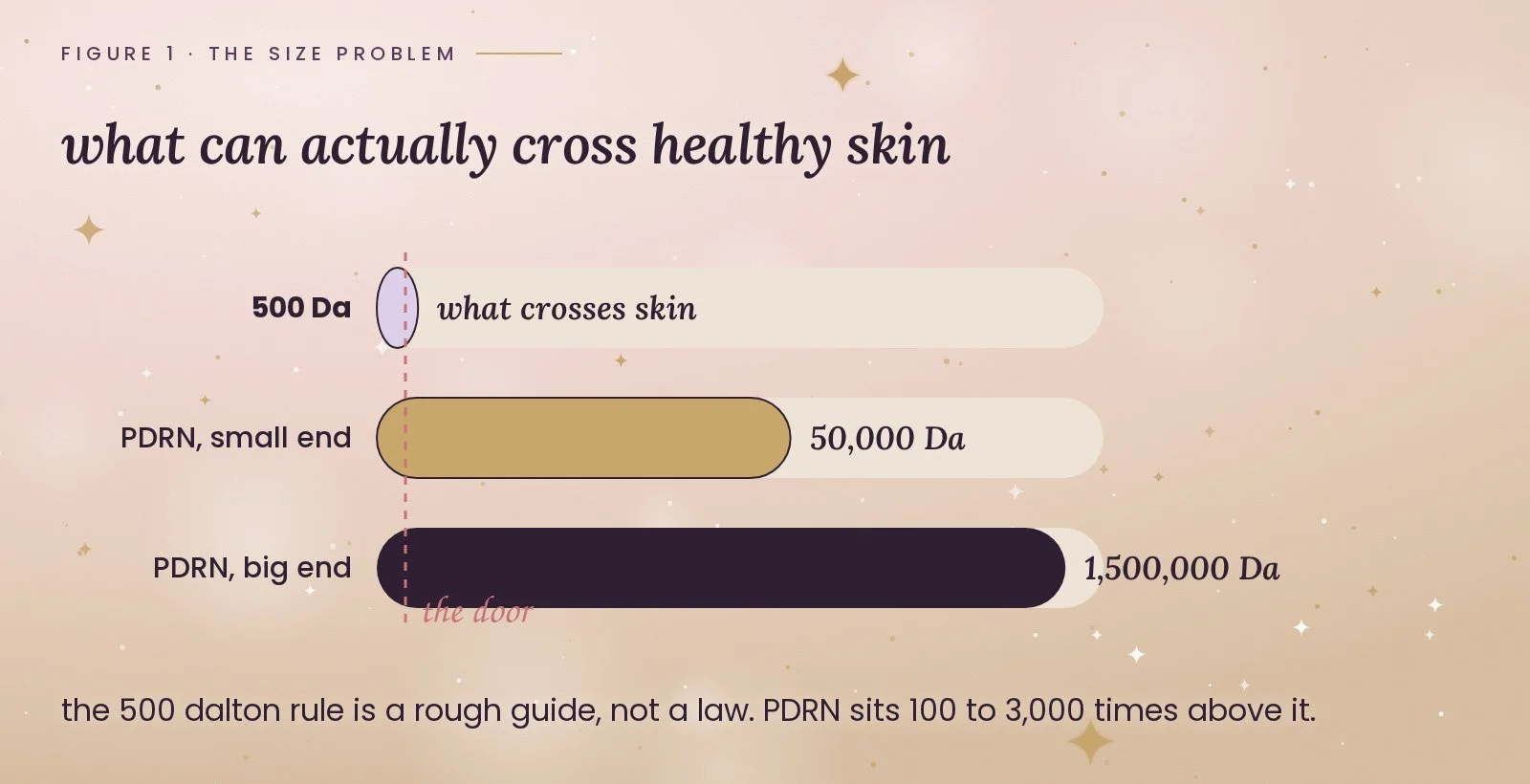
There is an old and boring rule in dermatology called the 500 dalton rule: molecules much above about 500 daltons do not cross intact skin by passive diffusion in meaningful amounts. It is a rough rule, not a law, but it is the right order of magnitude.
PDRN is 50,000 to 1,500,000 daltons.
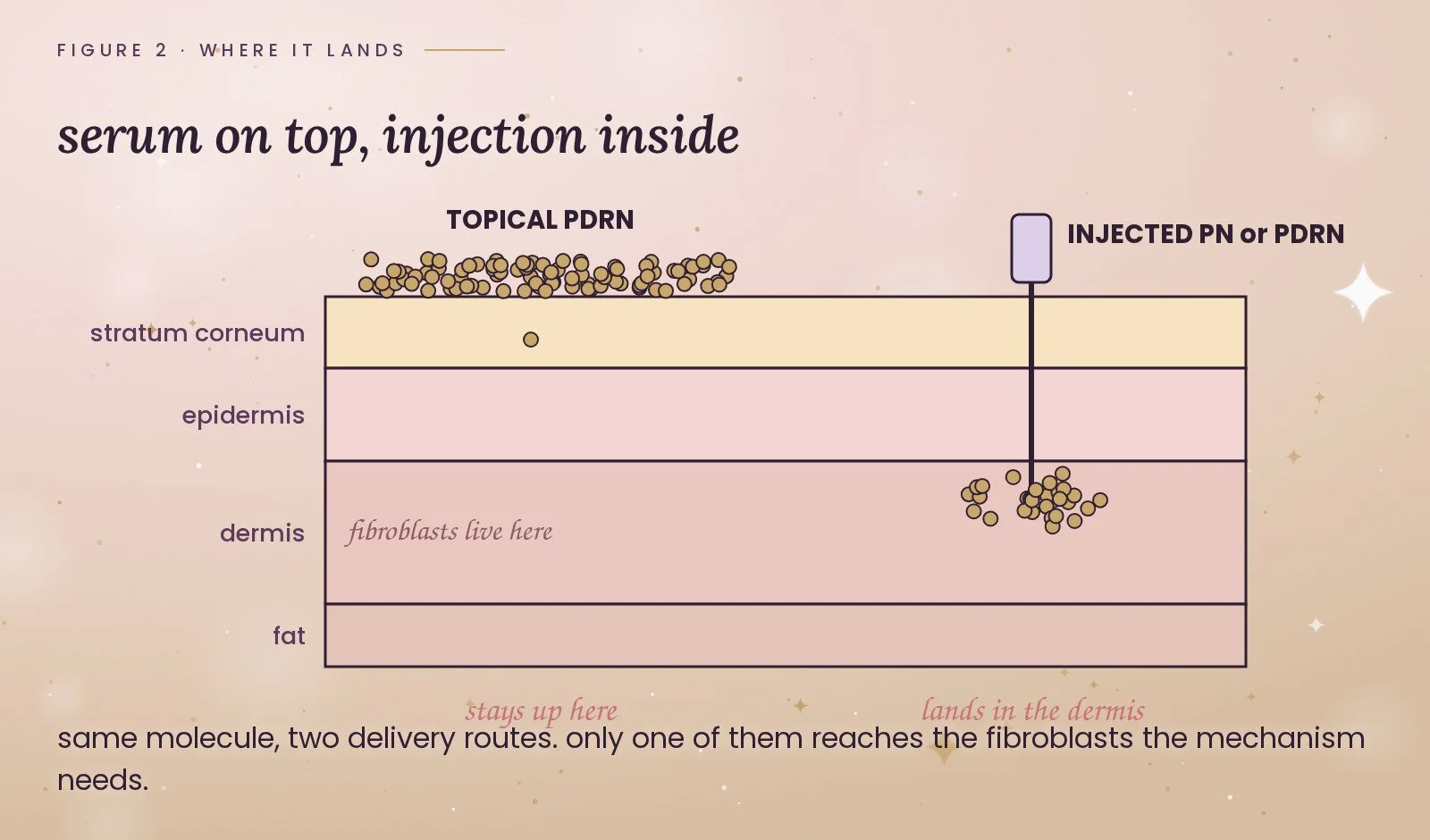
That is not slightly too big. That is one hundred to three thousand times over the line. An intact PDRN molecule sitting on healthy stratum corneum is a sofa at the front door of a dollhouse. Dermatologists reviewing the trend have said it plainly: standard topical PDRN does not reach the dermal fibroblasts where its targets are.
So when a serum promises the collagen results of the injectable, the claim is not being made about the same molecule arriving in the same place.
Then why does my PDRN serum feel like it works
Because it might be doing something, just not the something on the front of the box.
A few honest possibilities, in order of how much I believe them.
The rest of the formula. PDRN serums are rarely PDRN alone. They are usually loaded with humectants, panthenol, niacinamide, fermented extracts and silicones. A well-built barrier serum feels lovely and improves how skin looks in two weeks. That result is real. The attribution is the problem.
Fragments and the epidermis. Not every molecule in a PDRN mixture is 200 kDa. Smaller fragments exist, and effects on the upper layers are plausible even if the dermal story is not.
Compromised skin. After a laser, microneedling or anything that breaks the barrier, the door is open. Post-procedure is the setting where topical PDRN makes the most physiological sense, and it is where most clinics actually use it.
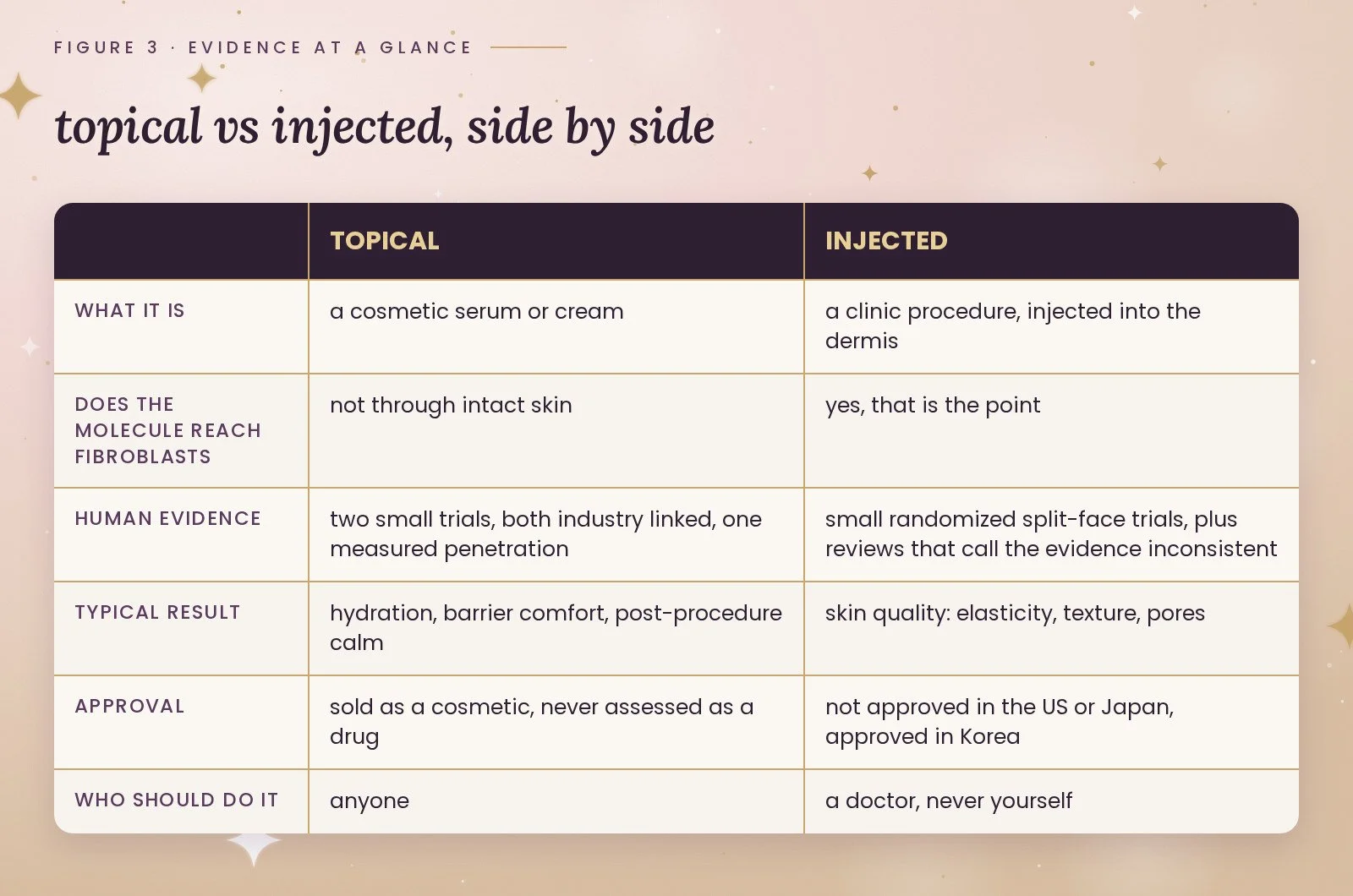
The published topical evidence is thin and young. A December 2025 study of a plant-derived PDRN ran ten participants for four weeks and reported less water loss and better periorbital elasticity, authored by the company developing the ingredient. A July 2026 study of a 0.1% eye cream at a specific 850 kDa size ran a randomized, double-blind, split-face design for 28 days, measured penetration by confocal Raman spectroscopy, and reported roughly double the dermal thickness increase of retinol, with crow's feet improving about 20 to 23% versus 6 to 7%.
That second one is genuinely interesting, and it is also the exact trap. The evidence belongs to that molecular weight, that concentration, that vehicle, that study. It does not transfer to every jar with PDRN on it, any more than one good vitamin C trial makes all vitamin C serums work.
The evidence belongs to a molecular weight, a concentration and a formula. It does not belong to four letters.
The question to ask a brand is never "does it contain PDRN". It is: at what molecular weight, at what concentration, and did you measure whether it got anywhere.
The injected version
This is the part people actually mean when they say PDRN works.
Injected PN and PDRN, usually sold as skin boosters, are placed intradermally across the face, typically three sessions two to four weeks apart, then maintenance every three to six months. The molecule is delivered exactly where its receptors are, which resolves the entire size problem by going around it.
The evidence is better than the topical evidence and still smaller than the internet implies.
The cleanest study I can point to is a randomized, double-blind, split-face trial in 27 women, mean age about 49, comparing a PN filler against non-crosslinked hyaluronic acid around the eyes: three sessions at two-week intervals, followed to 28 weeks. Global aesthetic improvement and patient-rated scores were not significantly different between the two sides. PN did better on the instrument measures: elasticity, hydration, roughness and pore volume.
Read that carefully, because it is a good example of how to read this whole category. The eyes of the people in the study did not look dramatically different depending on which side got PN. The skin quality measurements did.
Newer work is mostly about technique rather than proof of concept: intradermal versus subdermal placement, needle versus jet injector, pain with different formulations. That is what a field looks like when it has decided the thing works and moved on to optimizing it, which is not the same as the thing being settled. A 2024 narrative review of PN and PDRN in dermatology concluded the evidence base is still inconsistent, with small studies, varied protocols and no standardized manufacturing across suppliers.
Safety, from the same literature: redness, swelling and bruising for one to three days, small lumps at injection points, and a hard contraindication if you are allergic to fish. No long-term safety data exists, because the category is not old enough to have any.
The regulatory part, which is the part nobody posts about
In the United States, no injectable PDRN or PN product is FDA approved for injection into skin. Clinics that offer it are using imported product outside that approval. Topical PDRN is sold as a cosmetic, which means it was never evaluated as a drug for either safety or efficacy.
In Japan, injectable PN and PDRN are not approved under the 薬機法 either. Clinics import it themselves and use it in 自由診療. That is legal, and it is also worth understanding what it means: no domestic trial, no domestic quality control on the batch in front of you, and no domestic adverse event reporting behind it. Your protection is the clinic's judgment.
In Korea, where most of these products come from, they are approved and mainstream.
None of that makes the treatment bad. It makes the answer to "is this approved" more interesting than yes or no, and it means the clinic you pick is doing more of the work than the molecule is.
The line I will not blur
Do not inject anything you bought online.
There are vials of PDRN and PN sold as research chemicals, and there are people on the internet injecting them at home. A vial labelled research use only was not made for humans. Nobody verified its sterility, nobody confirmed the contents match the label, and the dose is a guess. Injecting into skin, with no training, using unverified material, is how you get granulomas, infections and scarring on the one face you have.
Clinic, doctor, or nothing. That is the whole rule.
What I would actually do
If you want what the injectable does, book the injectable with a doctor, and expect skin quality changes rather than a new face. Ask them what they inject, at what molecular weight, and where they source it.
If you want a nice serum, buy the nice serum and enjoy it as a nice serum. Use it after procedures, where it makes the most sense. Do not pay a premium for four letters that are physically unlikely to be reaching your fibroblasts.
And if a brand tells you their cream does what the injection does, ask for the molecular weight. Watching what happens next is genuinely informative.
Not medical advice. I am a cell biologist, not your doctor, and nothing here replaces a consultation with one.
Keep reading
Your SPF 30 foundation is protecting you like an SPF 3: the same habit of reading the number the way the lab measured it, applied to the bottle you already own.
Peptides, ranked by evidence: which ones have human data at the dose in the jar, and which are fairy dust.
If you want your own routine read this way, the consultation tiers are on the For you page. If you are a brand and this article made you nervous about a product page, What I check explains what a review looks like.
Sources
- Squadrito F et al. Pharmacological activity and clinical use of PDRN. Front Pharmacol, 2017.
- Kumar et al. Polynucleotides and polydeoxyribonucleotides in dermatology, a narrative review. J Cutan Aesthet Surg, 2024.
- Lee et al. Comparison of the effects of polynucleotide and hyaluronic acid fillers on periocular rejuvenation: a randomized, double blind, split face trial. J Dermatolog Treat, 2022.
- Bae et al. Efficacy and safety of intradermal versus subdermal injection of polynucleotide for facial improvement: a prospective split face study. J Cosmet Dermatol, 2026.
- Dermatology Times. Social media mythbusters: PDRN serums, 2026.
- ClinicJapan. PDRN skincare 2026, what the new topical trials show, and the Japanese regulatory status of PN injections, 2026.
