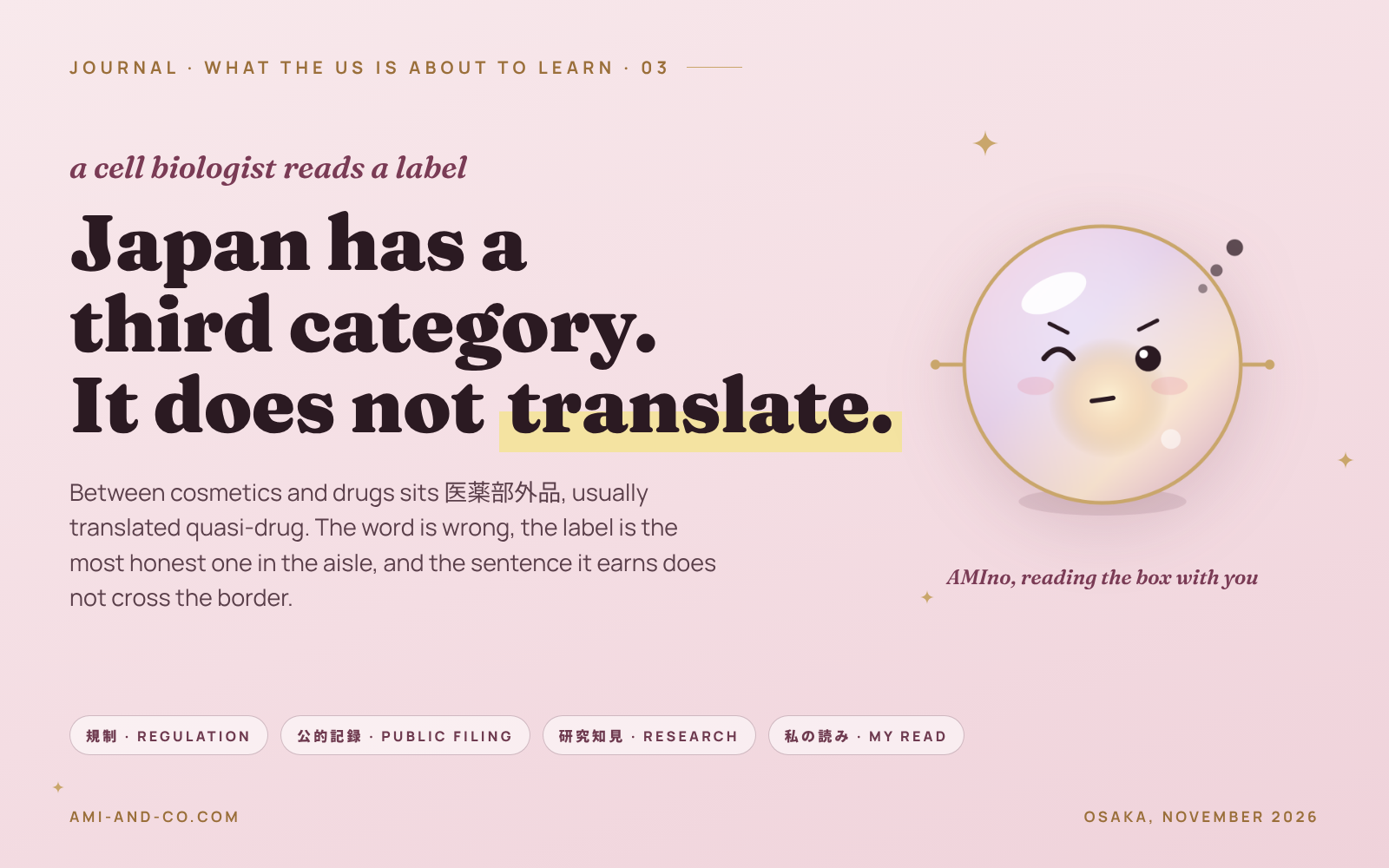
In one breath. Most countries sort a jar of cream into two boxes, cosmetic or drug. Japan has three. The middle one, 医薬部外品, is usually translated "quasi-drug", and the word is wrong: it means a named active, at a fixed concentration, in a formula the health ministry reviewed before sale, with a claim the brand applied for rather than wrote. It is the most honest label in the Japanese beauty aisle. It is also the one that loses its sentence at the border.
Every section carries an evidence label: 規制 (regulation), 公的記録 (public filing), 研究知見 (research), 私の読み (my read). When I show you a claim, you will know what kind of claim it is. This is piece 3 of the series "What the US is about to learn".
Two boxes, then three · 規制 regulation
Most countries sort a jar of cream into one of two boxes. It is a cosmetic, or it is a drug. The United States does it by intended use. The EU does it by definition. Either way, there are two boxes, and everything in the beauty aisle is in the first one.
Japan has three.
Between cosmetics (化粧品) and drugs (医薬品) sits a category called 医薬部外品. The usual English rendering is "quasi-drug." I would like to retire that word by the end of this piece, because it is the reason so much Japanese skincare arrives in English sounding either illegal or like it is hiding something. It is neither. It is the most honest label in the Japanese beauty aisle, and the one I look for first.
What the label actually means · 規制・公的記録 regulation, public filing
A quasi-drug is a product with a named active ingredient, at a fixed concentration, in a formulation that was reviewed by the Ministry of Health before it went on sale. The review covers the active, the amount, the safety data, and the exact sentence the brand is allowed to print about it. The brand does not choose the sentence. It applies for it.
A cosmetic in Japan can say things from a fixed list. There are fifty-six permitted phrases, and they are all about appearance and condition: moisturizes, keeps skin supple, makes dry fine lines less noticeable. No approval, a notification, and the list.
A quasi-drug can say one of a small number of things a cosmetic cannot. The big three on a face are these.
- It prevents spots and freckles by suppressing melanin production. This is what 美白 means in Japanese regulation. It does not mean lightening. The sentence is about prevention, and the mechanism is written into it.
- It improves wrinkles. This one is new. POLA's Wrinkle Shot was the first product in Japan allowed to print シワを改善 after its active, a peptide the company calls ニールワン, was approved in 2016. The company had been working on the mechanism since 2002. Shiseido's retinol followed within months. Before 2016, no product in Japan could say it improved a wrinkle, only that it made dry fine lines less noticeable.
- It prevents acne, or it prevents rough skin. Usually glycyrrhizic acid or allantoin, usually at a concentration that has been on the approved list for decades.
On the package, the word you are looking for is 薬用. It means the product is in the third box. If the label says 薬用 and names an active with a percentage, the government read that file.
Why the word is wrong · 私の読み my read
"Quasi-drug" is a literal translation and a bad one. In English, quasi means almost. An American reads "almost a drug" and hears one of two things: that the product is a drug being sold without the paperwork, or that it is a cosmetic pretending to be one. The FDA hears the first. The customer hears the second.
The Japanese word does not carry either meaning. 部外 means outside the category. A 医薬部外品 is a thing that is outside drugs, on purpose, with its own rules. The closest honest English I have found is "a reviewed active cosmetic," and I am aware that will never fit on a label.
Korea has a version of the same idea, 기능성화장품, which the MFDS translates as functional cosmetics. Taiwan and China each have a special category too. Japan's is the oldest and the most conservative. It is also the one that sends the most products to the US with a sentence on the front that has to come off at the border.
What happens to the claim at the border · 規制 regulation
This is the part I spend most of my working week on, so let me be exact.
The approval is Japan's. It earns nothing in the United States. The FDA does not recognise the category, and a product is sorted into the drug box or the cosmetic box by what the label says it does. "Prevents spots by suppressing melanin production" is a structure and function claim. In the US, that sentence makes the product a drug, and an unapproved one. "Improves wrinkles" does the same. The active can stay in the bottle at the same percentage. The sentence cannot.
In the EU the problem is different and the outcome is the same. There is no middle category, so a product is a cosmetic or a medicinal product, and a cosmetic may not claim a pharmacological mechanism. The melanin sentence goes. The wrinkle sentence has to be supported by evidence held in the product file, written in appearance language, and defended if asked.
So the same cream crosses the ocean and loses the one sentence it spent fourteen years earning. What it keeps is the thing I actually care about: the active, the percentage, and a safety file that a regulator has already read.
What this means if you buy Japanese skincare · 私の読み my read
If you are reading this from the US or Europe and you buy from Japan, here is the practical version.
Look for 薬用 on the front. Then look for the active and its percentage on the back. Tranexamic acid, niacinamide, 4MSK, arbutin, a vitamin C derivative, retinol, ニールワン. If the product names one and gives a number, it was reviewed. If the English listing says "whitening" or "brightening," the translator is the one making the claim, not the regulator. The Japanese sentence was about prevention, and it was narrower than the word you are reading.
And if a Japanese product is sold to you in English with the word "approved" anywhere near it, read the rest of the sentence slowly. Approved in Japan, for one active, at one concentration, for one phrase. That is a real thing and a good thing. It is not FDA approval, and nothing in the cosmetic aisle is.
What this means if you are the brand · 私の読み my read
I will keep this short, because it is the thing I do for a living and this is not the page for that.
The category you are proud of does not travel. The evidence behind it does. Before anyone translates the front of the box, separate the two. Keep the active, the percentage, the stability data, the safety file. Rewrite the sentence in the language of appearance, in the country you are entering, with the mechanism left for the clinic to explain in person. The product you end up with says less and can prove all of it.
That is usually a stronger product than the one that left Osaka.
Amisha is a cell biologist in Osaka. She reads product pages and evidence for Japanese skincare brands going abroad. This piece is her reading of the categories, not legal advice; a regulatory counsel in the destination country has the final word.
Sources. 厚生労働省, 化粧品の効能の範囲の改正について (the 56 permitted cosmetic claims, 2011). POLA Orbis, Wrinkle Shot and ニールワン approval (2016; Fashionsnap, Oct 2026, on the renewal). Shiseido, press release on the first シワを改善 approval for pure retinol (Feb 2017). Regulation (EC) No 1223/2009 (EU cosmetics; no intermediate category). FDA, "Is It a Cosmetic, a Drug, or Both?" (intended use). MFDS, functional cosmetics (기능성화장품) definition.
